
$194.99
$1.52/GB
Corsair128GB (4x32)
In Stock
In stock
Compare 332 128GB kits across DDR4 and DDR5 — for VMs, heavy creation, and large local AI. Prefer QVL-validated 2×64GB when your board supports it.
Avg $/GB
$14.68/GB
DDR4 from
$194.99
DDR5 from
$395.00
Kits tracked
332
Stock signal
329
Updated
Aug 28, 2026
Buy timing
Elevated
Bottom line
128GB is for workstations, heavy VMs, and large local AI — not gaming-only PCs (use 32GB). Prefer QVL-validated 2×64GB over 4×32GB on consumer boards; dense kits often run below peak EXPO/XMP. Across 332 tracked 128GB configs, the average is $14.68/GB; DDR5 averages $29.64/GB.
Buy this today
Skip if you only game — use 32GB prices or Best 32GB DDR5. Most creators/local AI start at 64GB / Best 64GB DDR5. Server ECC: Server prices.
| Platform | Prefer | Shop |
|---|---|---|
| AMD AM5 | 2×64GB · check QVL speed | AM5 hub |
| Intel LGA1851 | 2×64GB XMP UDIMM | Core Ultra |
| Creator step-down | 2×32GB 6000 CL30 | Best 64GB |
| ECC / server | Registered / ECC only | Server ECC |
Prices look elevated vs recent history
Prices are at the 95th percentile of our 6-week range — above recent averages. Consider waiting. View price trends
Best value right now
DDR5 — Lowest $/GB
TEAMGROUP
TEAMGROUP T-Create Expert Overclocking 10L CL42 DDR5 128GB Kit (2 x 64GB) 6400MHz (PC5-51200) Intel XMP 3.0 & AMD Expo Compatible Desktop Memory Module Ram Black - CTCED5128G6400HC42CDC01
Why are RAM prices high in 2026?
AI-driven demand redirected DRAM capacity toward HBM. Dense 128GB kits remain expensive — buy on platform fit and QVL, not peak advertised speed alone. Full analysis →
128GB is a workstation tier — multi-stream high-res video, large VM labs, and big local models. Confirm motherboard max capacity and QVL first; dense kits often run below the speeds you see on 32GB EXPO/XMP listings.
Prefer 2×64GB on dual-channel consumer boards when supported. Four-stick fills train harder and more often force speed downshifts. Enable XMP/EXPO only after a clean POST at JEDEC, then validate stability.
If 128GB is more than you need, start at 64GB prices or Best 64GB DDR5. For sizing help see How Much RAM Do I Need and Best RAM for Local AI.
| Workload | Minimum | Ideal |
|---|---|---|
| 8K/12K video editing (DaVinci Resolve) | 64GB | 128GB |
| Local AI — 70B-class models | 64GB | 128GB |
| Virtualization labs (many VMs) | 64GB | 128GB+ |
| 3D rendering (large scenes) | 32GB | 128GB |
| Heavy databases | 32GB | 128GB+ |
| Software dev (large Docker stacks) | 32GB | 64GB |
| Data science (large in-memory sets) | 32GB | 128GB |
| Gaming only | 16GB | 32GB |
Highlighted rows are workloads where 128GB is often the ideal capacity.
DDR4 128GB
$7.71/GB
avg per GB · 182 modules
$194.99 – $7599.00
High capacity on older platforms
DDR5 128GB
$29.64/GB
avg per GB · 130 modules
$395.00 – $6719.99
AM5 / LGA1851 workstation path
Laptop SO-DIMM
$11.10/GB
avg per GB · 18 modules
$735.32 – $2996.99
Rare — confirm mobile workstation support
Avg $/GB for 128GB desktop kits — updated daily
7d
+0.2%
30d
+0.6%
52w %ile
95th
$194.99
$1.52/GB
In stock

$199.89
$1.56/GB
In stock
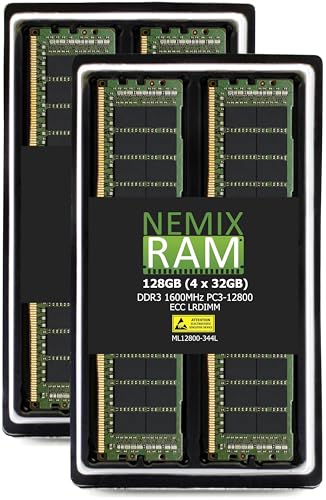
$199.89
$1.56/GB
In stock

$259.96
$2.03/GB
In stock

$276.89
$2.16/GB
In stock

$289.00
$2.26/GB
In stock

$302.01
$2.36/GB
In stock

$395.00
$3.09/GB
In stock

$492.01
$3.84/GB
In stock

$499.99
$3.91/GB
In stock

$536.74
$4.19/GB
In stock
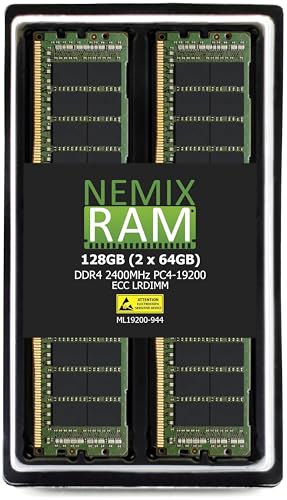
$577.49
$4.51/GB
In stock

$577.49
$4.51/GB
In stock

$577.96
$4.52/GB
In stock
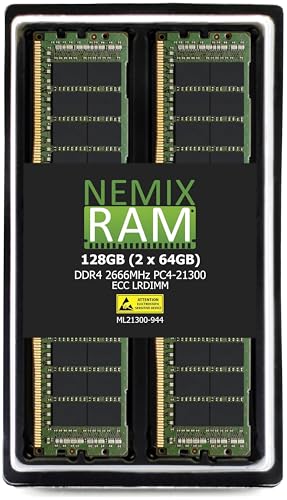
$595.00
$4.65/GB
In stock

$620.03
$4.84/GB
In stock

$735.32
$5.74/GB
In stock

$794.49
$6.21/GB
In stock
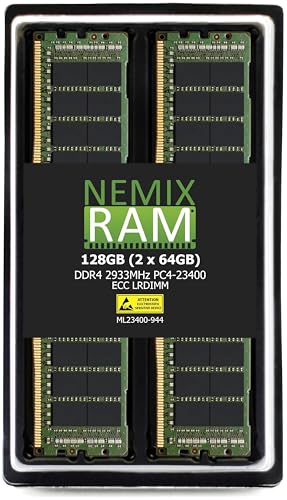
$796.99
$6.23/GB
In stock
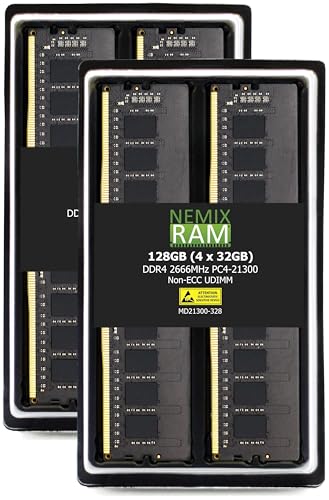
$798.89
$6.24/GB
In stock

$799.00
$6.24/GB
In stock
$799.00
$6.24/GB
In stock

$799.00
$6.24/GB
In stock

$799.99
$6.25/GB
In stock
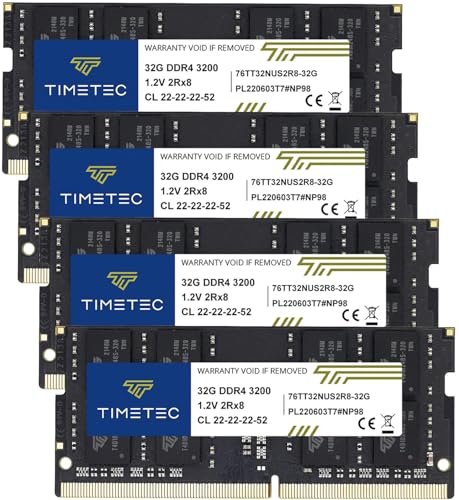
In stock

$838.49
$6.55/GB
In stock
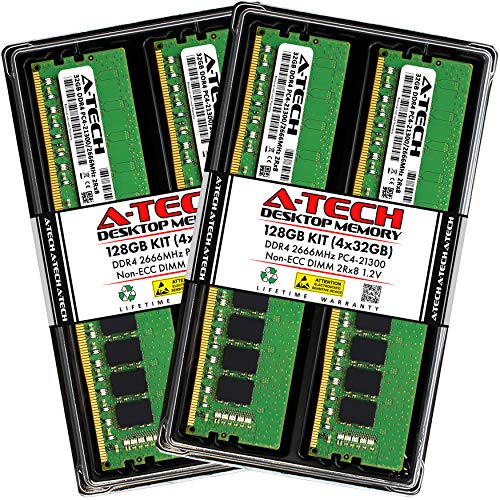
$853.56
$6.67/GB
In stock

$867.00
$6.77/GB
In stock

$878.16
$6.86/GB
In stock

$892.36
$6.97/GB
In stock

$898.90
$7.02/GB
In stock
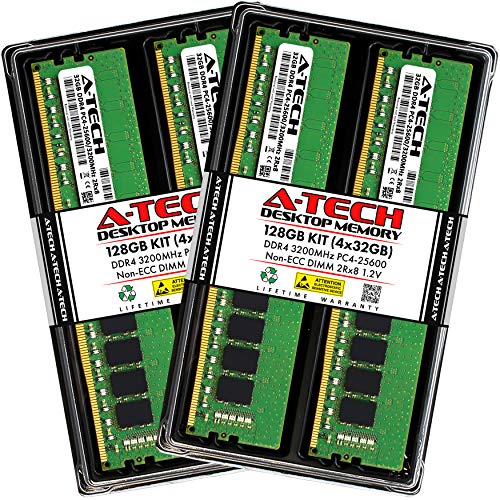
$904.36
$7.07/GB
In stock

$916.99
$7.16/GB
In stock

$916.99
$7.16/GB
In stock

$916.99
$7.16/GB
In stock
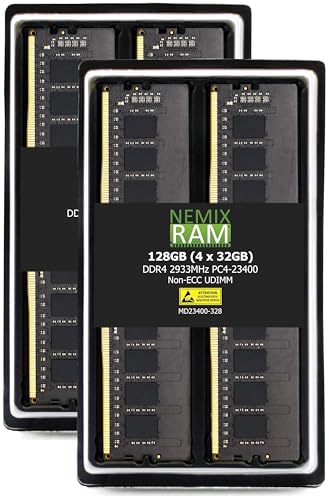
$916.99
$7.16/GB
In stock

$949.99
$7.42/GB
In stock
In stock

In stock
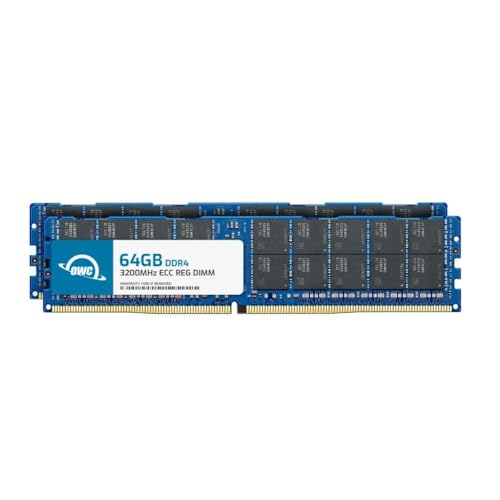
$996.98
$7.79/GB
In stock
$996.98
$7.79/GB
In stock

$1,006.95
$7.87/GB
In stock

$1,007.92
$7.87/GB
In stock
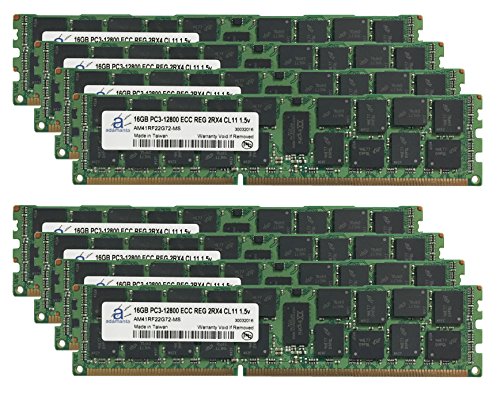
$1,007.92
$7.87/GB
In stock

$1,007.92
$7.87/GB
In stock
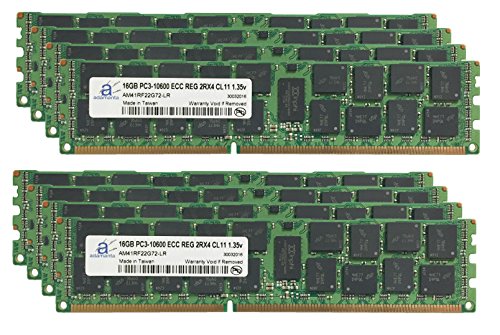
$1,007.92
$7.87/GB
In stock
$1,007.92
$7.87/GB
In stock
$1,007.92
$7.87/GB
In stock
$1,007.92
$7.87/GB
In stock
$1,007.92
$7.87/GB
In stock
Prices updated daily. Product prices and availability are accurate as of the date/time indicated and are subject to change. Any price and availability information displayed on Amazon.com at the time of purchase will apply to the purchase of this product.
Prices updated daily. Product prices and availability are accurate as of the date/time indicated and are subject to change. Any price and availability information displayed on Amazon.com at the time of purchase will apply to the purchase of this product.
Heavy workstation and server loads: many VMs or large Docker labs, multi-stream 8K editing, big 3D scenes, and large local LLM / AI inference. Gaming alone does not need 128GB — use 32GB (or 64GB for creators).
Often yes for large CPU/hybrid inference of ~70B-class models at common quantizations, with headroom for the OS and apps. Exact fit depends on model size, quantization, and GPU VRAM offload — see the local AI guide for sizing.
If your board requires DDR5 (AM5, LGA1851), you have no choice. On dual-capable older platforms, DDR5 can help bandwidth-heavy AI and databases, but confirm QVL and expect denser kits to run below peak EXPO/XMP speeds more often.
On dual-channel consumer boards, prefer 2×64GB over 4×32GB when supported — fewer sticks usually train more reliably and hold higher stable speeds. Always check motherboard max capacity and QVL before buying.
Yes. For gaming-only PCs in 2026, 32GB is the practical buy. 128GB only makes sense if the same machine also runs heavy VMs, large local AI, or professional high-res video.
It can. Dense dual-rank modules and four-stick fills often force lower stable JEDEC/XMP speeds on consumer memory controllers. Budget for validation time and check your board’s QVL for the exact kit.